The digital landscape is a fiercely competitive arena. Every pixel, every byte, and every line of code plays a role in how your website performs. Yet, many businesses overlook one of the most powerful — and often underutilized — tools in their SEO arsenal: schema markup. This structured data, when correctly implemented, acts as a translator, helping search engines truly understand the context of your content, leading to those coveted rich snippets and enhanced visibility.
But here's the catch: implementing schema markup manually can be a labyrinthine task, riddled with technical complexities and prone to errors. This is precisely where schema markup generators and tools become indispensable. For anyone serious about elevating their search presence, comparing schema markup generators & tools isn't just an option; it's a strategic necessity. The right tool can transform a daunting technical challenge into a streamlined, automated process, ensuring your site speaks the search engine's language fluently and without costly missteps.
At a Glance: Your Schema Markup Toolkit Guide
- Schema Markup Demystified: It's code that gives search engines more context about your content, powering rich results.
- Why Tools Matter: They simplify complex structured data, reduce errors, and save you immense time.
- Key Decision Factors: Look for ease of use, broad schema type support, real-time validation, and scalability.
- Types of Tools: From free online generators to comprehensive SEO suites and specialized enterprise solutions.
- The Right Fit: Your choice depends on your technical skill, website size, and specific SEO goals.
- Continuous Improvement: Always validate your schema and monitor its performance in Google Search Console.
Decoding Schema Markup: Your Website's Secret Language
Imagine you've written an incredible recipe for artisanal sourdough. A human reader immediately understands it's a recipe, can identify ingredients, cooking times, and step-by-step instructions. But a search engine, without explicit guidance, might just see a jumble of text, numbers, and links. This is where schema markup steps in.
Schema.org is a collaborative, community-driven effort by major search engines (Google, Bing, Yahoo!, Yandex) to create a universal vocabulary for structured data. When you add schema markup (typically in JSON-LD format) to your website, you're essentially annotating your content with specific labels. You're telling Google, "Hey, this is a Recipe. Here are the ingredients, here's the prepTime, and this is the aggregateRating."
This explicit instruction allows search engines to go beyond simply indexing keywords. They can understand the relationships between entities on your page, leading to richer, more informative search results. Think star ratings, product prices, event dates, FAQ accordion toggles, or even direct answers to user questions—these are all powered by structured data, transforming a plain blue link into a highly engaging, visually appealing "rich snippet."
Without these semantic hints, your content might rank well, but it might not stand out. In a crowded search results page, a rich snippet can significantly boost your click-through rates (CTR), drawing more organic traffic to your site even if your traditional ranking position isn't always #1. The initial setup might seem technical, but the payoff in visibility and engagement is undeniable.
Why You Can't Afford to Skip a Schema Markup Tool
For many, the mention of "coding" or "structured data" immediately triggers alarm bells. The truth is, writing valid, comprehensive schema markup by hand for every page on your site is incredibly complex, time-consuming, and error-prone. This is precisely why schema markup tools aren't just a convenience; they're a necessity.
The Automation Advantage: Saving Time and Sanity
Manually crafting JSON-LD scripts, ensuring correct syntax, and linking every property to its corresponding value is a meticulous process. A single misplaced comma or an incorrect property name can invalidate your entire schema. Tools automate this. You input details into user-friendly fields, and the tool generates the flawless code for you. This frees up countless hours for more strategic SEO work.
Ensuring Accuracy and Validity: The Critical Role of Feedback
One of the biggest risks of manual implementation is introducing errors. Invalid schema won't just fail to deliver rich snippets; it could potentially confuse search engines or, in extreme cases, even lead to penalties if considered spammy. The best schema markup tools come equipped with real-time validation, instantly flagging issues so you can correct them before deployment. Think of it as a built-in quality control mechanism that acts as your first line of defense against implementation blunders.
Scaling Your Structured Data Efforts: From Pages to Thousands
If you manage a small website with just a handful of pages, manual implementation might seem feasible. But what about e-commerce sites with thousands of products, or news portals with hundreds of articles published daily? Manually adding schema to each new piece of content is simply unsustainable. Tools, especially those designed for scalability, allow for templated generation, CMS integrations, or even API-driven solutions that apply schema across your entire site automatically, ensuring consistent and correct markup at scale.
Staying Competitive: Because Your Rivals Aren't Sitting Still
In the ever-evolving world of SEO, doing nothing is falling behind. Your competitors are likely already leveraging structured data to capture rich snippets and attract more clicks. By employing a robust schema markup strategy, powered by the right tools, you're not just participating in the race; you're equipping yourself with the means to lead it. It's about maximizing your search visibility and ensuring your website makes the strongest possible impression in the search results.
What to Look For: Essential Criteria When Comparing Schema Markup Tools
Choosing the right schema markup generator isn't a one-size-fits-all decision. What works for a small local business might be insufficient for a large e-commerce platform. Here are the crucial factors to consider when you're evaluating your options:
1. Ease of Use and Interface
How intuitive is the tool? Can you generate valid markup without needing extensive technical skills, or does it require a deep understanding of JSON-LD? For beginners, a wizard-style interface that guides you step-by-step is invaluable. Experienced SEOs might prefer a more direct, code-focused approach with advanced customization options. The goal is to minimize friction and prevent errors.
2. Schema Type Coverage
Does the tool support the specific types of schema markup relevant to your website? Most tools cover common types like Article, Product, and LocalBusiness. However, if you need specialized schema for, say, a MedicalWebPage, a Dataset, or a specific type of Event, you'll need a tool with broader support. Check if it handles complex nested schema (e.g., a Product schema that includes Offer, AggregateRating, and Brand).
3. Validation and Error Checking
This is non-negotiable. A good tool provides real-time validation as you build your schema, highlighting errors or missing required properties. After generation, it should ideally integrate with or link directly to Google's Rich Results Test or the Schema.org Validator to confirm your output is valid and eligible for rich snippets. This prevents you from deploying faulty code that could harm your visibility.
4. Deployment and Integration Options
How easily can you get the generated schema onto your website?
- Copy/Paste: Basic tools provide JSON-LD code you manually insert into your HTML.
- CMS Plugins: For WordPress, plugins automate insertion.
- Tagging Interface: Some tools let you "point and click" elements on your live page to generate schema.
- API/CMS Integration: Enterprise solutions often offer direct integrations to automatically push schema to your site.
5. Scalability and Automation
For larger websites or those with frequently updated content, manual schema generation per page is impractical. Look for features like:
- Templates: Create reusable schema templates.
- Bulk Generation: Apply schema across multiple pages simultaneously.
- CMS Connectors: Automatically integrate with platforms like WordPress, Shopify, or Magento.
- Dynamic Schema: Automatically pull data from your site's content to generate schema properties.
6. Cost and Support
Schema markup tools range from completely free to premium subscription services.
- Free Tools: Excellent for beginners, quick one-off tasks, and understanding the basics. They often have limitations in terms of schema types, validation depth, or scalability.
- Paid Tools/Suites: Offer broader functionality, advanced features, dedicated support, and often integrate schema generation with other SEO capabilities like rank tracking or site audits.
- Consider the level of customer support available, especially for paid tools, as you might encounter complex implementation scenarios.
7. Output Format
While JSON-LD is the format recommended by Google and generally the easiest to implement, some tools might also support Microdata or RDFa. JSON-LD is usually embedded in the <head> or <body> of an HTML document, making it cleaner and less intrusive to your existing page content. When you need to [Generate schema markup]generate schema markup, opt for JSON-LD if possible.
A Head-to-Head Look: Popular Schema Markup Generators & Tools
Let's dive into some of the most widely used and effective schema markup tools available today, categorized by their typical use case.
Free Online Generators: Quick, Simple, and Cost-Effective
These tools are perfect for beginners, small businesses, or anyone needing to generate schema for a few pages without investing in a full SEO suite.
- Google Structured Data Markup Helper
- What it is: A free tool from Google itself, designed to help you mark up elements on your web page.
- How it works: You paste a URL or HTML, then visually highlight elements on the page (e.g., a product name, price, or author) and assign them a schema type (e.g., "Article," "Product"). The tool then generates the JSON-LD or Microdata.
- Best for: Beginners, small sites, learning the ropes, marking up existing pages without direct code access.
- Pros: Straightforward, direct from Google (so you know it's aligned with their guidelines), visual tagging makes it easy.
- Cons: Limited schema types supported, doesn't validate in real-time (you need to copy the code to the Rich Results Test), not scalable for large sites.
- Merkle Schema Markup Generator
- What it is: A popular, free, and simple JSON-LD schema generator developed by Merkle and dentsu.
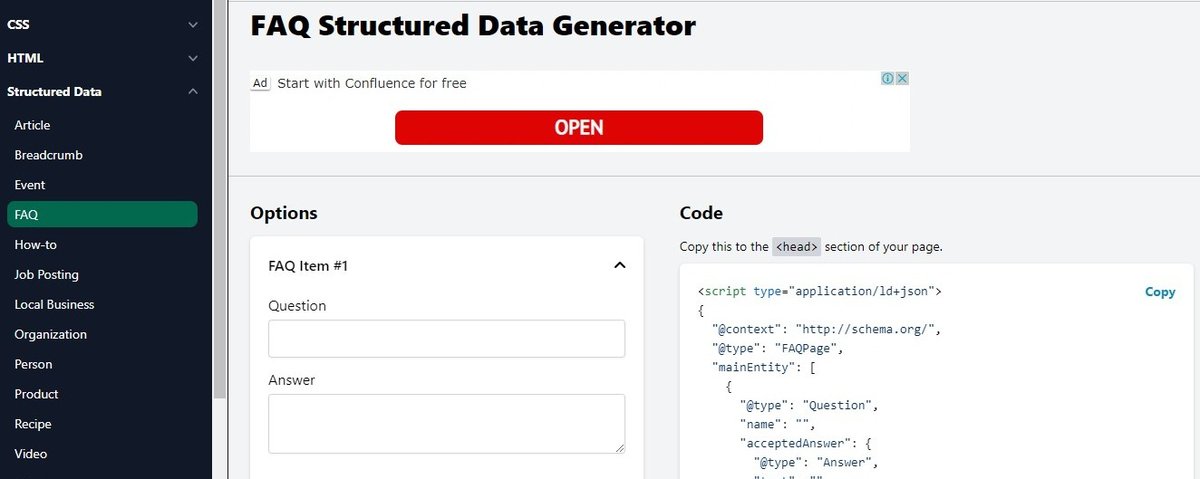
- How it works: You select a schema type (e.g., Article, Product, LocalBusiness, FAQPage), fill out simple form fields, and the tool instantly generates the JSON-LD code.
- Best for: Anyone needing to quickly generate clean JSON-LD for common schema types.
- Pros: Very easy to use, clean interface, supports many common schema types, generates JSON-LD directly.
- Cons: No real-time validation beyond basic field requirements, limited to single page generation, no advanced features or integrations.
- Microdata Generator by SEOChat
- What it is: A free tool focused on generating schema in Microdata format.
- How it works: You select a content type and fill in the details. It generates HTML with Microdata attributes embedded.
- Best for: Users who specifically need Microdata (though JSON-LD is generally preferred by Google) or have older sites still using Microdata.
- Pros: Simple interface, good for those with specific Microdata requirements.
- Cons: Focuses on Microdata (less common and often harder to implement than JSON-LD), limited range of schema types.
WordPress Plugins: Seamless Integration for CMS Users
If your website runs on WordPress, plugins offer the most integrated and often automated approach to schema.
- Yoast SEO Plugin
- What it is: One of the most popular WordPress SEO plugins, with robust built-in schema capabilities.
- How it works: Yoast automatically generates schema for your posts, pages, and products based on your site's settings and content. For example, it will automatically mark up your articles as
Articleschema, complete with author, publish date, and image. You can also manually adjust schema types for individual posts. - Best for: Any WordPress user looking for an all-in-one SEO solution that handles schema without much manual effort.
- Pros: Deep integration with WordPress, automates many common schema types, user-friendly settings, often compatible with other plugins.
- Cons: Primarily for WordPress, advanced customization might require a paid premium version or other add-ons.
All-in-One SEO Suites: Comprehensive Platforms with Integrated Schema
These tools offer schema generation as part of a broader suite of SEO features, ideal for those who want to manage all their SEO efforts from one platform.
- Search Atlas
- What it is: A comprehensive SEO solution that includes a robust schema markup tool within its extensive feature set.
- How it works: Search Atlas provides an intuitive interface to simplify structured data creation. It can identify markup opportunities on your site and automate the generation process for efficiency.
- Best for: Businesses and SEO professionals seeking a streamlined solution for technical SEO, content creation, keyword research, and backlink analysis, all under one roof.
- Pros: Solid schema support integrated with other vital SEO features, easy to use, designed for both beginners and advanced users, aims for broader workflow integration.
- Cons: As part of a larger suite, the cost might be higher than standalone schema tools if you only need schema.
- Rank Ranger
- What it is: An all-in-one SEO platform offering a schema markup generator alongside rank tracking, site audits, and other SEO tools.
- How it works: Its schema generator is designed for ease of use, allowing you to create structured data quickly. It also provides validation and reporting to ensure your schema is functioning correctly.
- Best for: Users who need efficient schema generation and monitoring combined with a broader set of SEO functionalities.
- Pros: Simple to use, provides schema validation and reporting, part of a comprehensive SEO suite.
- Cons: May require a subscription to the full platform, schema features might not be as deep as specialized schema-only tools.
Advanced & Enterprise Solutions: Scalability and Automation
For large websites, agencies, or complex implementation needs, specialized tools offer greater control, scalability, and automation.
- Schema App
- What it is: A dedicated, comprehensive schema markup solution known for its scalability and automation capabilities.
- How it works: Schema App allows users to manage and automate structured data across large websites. It supports a wide array of schema types and integrates with various content management systems (CMS) to streamline deployment.
- Best for: Businesses of all sizes, but particularly shines for large-scale websites or agencies that need robust, consistent, and accurate schema markup across many pages.
- Pros: Very comprehensive, supports a vast range of schema types, strong focus on scalability and automation, excellent for consistent schema deployment, offers robust reporting.
- Cons: Typically a paid subscription, which can be a significant investment for smaller sites.
Common Pitfalls and How to Sidestep Them
Even with the best tools, schema markup isn't entirely "set it and forget it." Awareness of common mistakes can save you a lot of headaches.
- Invalid Markup: This is the most common pitfall. A simple typo, missing required property, or incorrect nesting can render your schema useless.
- Sidestep: Always run your generated schema through Google's Rich Results Test and the Schema.org Validator before deploying. Most good tools integrate this step.
- Over-Markup or Under-Markup: Marking up content that isn't actually visible to users (e.g., hidden keywords) or marking up irrelevant information can be considered spammy. Conversely, missing key opportunities for schema can leave visibility on the table.
- Sidestep: Follow Google's Structured Data Guidelines strictly: only mark up content that is visible on the page. Use your tool to identify all relevant elements that could have schema.
- Ignoring Google's Guidelines: Google has specific quality guidelines for structured data. Violating these can lead to manual actions or your rich snippets being ignored.
- Sidestep: Regularly review the official Google Structured Data Guidelines. They evolve, and staying updated is crucial.
- Setting It and Forgetting It: Schema.org vocabularies are updated, and Google's interpretation of rich results can change. Your site content also changes. Outdated schema can become invalid or less effective.
- Sidestep: Periodically audit your schema markup. Review your Search Console "Enhancements" reports for any errors or warnings.
- Misinterpreting Schema Types: Using "Article" schema for a product page, or "LocalBusiness" when you're an e-commerce-only operation.
- Sidestep: Clearly understand the purpose and required properties of each schema type before applying it. Most tools guide you here, but double-check your input.
Beyond the Tool: Best Practices for Schema Markup Success
While a powerful generator simplifies the process, your strategy for implementing structured data should extend beyond merely creating code.
Start Simple, Then Expand
Don't feel pressured to implement every single schema type at once. Prioritize the core schema types most relevant to your business model and content (e.g., Organization, Website, Article, Product, LocalBusiness). Once you've successfully deployed and validated these, then explore more nuanced or specialized types like FAQPage, HowTo, or Event. This approach helps you gain confidence and see early results.
Test, Test, Test
This cannot be stressed enough. After you generate your schema, and especially after you've implemented it on your site, use Google's Rich Results Test to confirm it's valid and eligible for rich results. This tool not only validates your code but also shows you which rich results Google could generate from your structured data. It's your window into Google's interpretation of your markup. For any questions about [understanding rich snippets]understanding rich snippets, this test is invaluable.
Monitor Performance in Google Search Console
Once your schema is live and valid, keep an eye on the "Enhancements" section within Google Search Console. Here, you'll find reports for various rich result types (e.g., "Products," "FAQs," "Reviews"). These reports show you the status of your structured data, flagging any errors, warnings, or valid items. Monitoring these reports helps you identify issues quickly and track the impact of your schema over time.
Stay Updated
The world of schema markup and search engines is constantly evolving. Schema.org updates its vocabulary periodically, and Google often introduces new rich result types or modifies existing guidelines. Subscribe to SEO news sources, follow Google's Webmaster Blog, and keep an eye on your chosen schema tool's updates to ensure your knowledge and implementation remain current. Understanding topics like [JSON-LD versus Microdata]JSON-LD versus Microdata can also help you stay ahead.
Consider a Hybrid Approach
For ultimate control, some advanced users adopt a hybrid strategy. They might use a schema generator for the initial, complex setup or for bulk creation, then manually fine-tune specific properties or add custom schema that the tool doesn't explicitly support. This combines the efficiency of automation with the precision of manual intervention. Integrating schema with [general SEO best practices]general SEO best practices ensures a holistic approach to your site's visibility.
Your Path Forward: Choosing the Right Tool for Your Needs
The best schema markup tool isn't necessarily the most expensive or the one with the most features; it's the one that best fits your specific needs, budget, and technical comfort level.
- For Beginners & Small Websites: If you're just starting, have a limited budget, or manage a small site, begin with free online generators like Merkle Schema Markup Generator or Google Structured Data Markup Helper. They'll get you accustomed to the process without overwhelming you.
- For WordPress Users: If your site is built on WordPress, leverage a plugin like Yoast SEO. The seamless integration and automated capabilities will save you significant time and effort, handling much of the heavy lifting behind the scenes.
- For Agencies & Large Enterprises: When scalability, automation, and comprehensive schema coverage are paramount, dedicated solutions like Schema App or integrated platforms like Search Atlas become invaluable. These tools offer the power to manage complex schema across thousands of pages consistently. Remember to check for capabilities like [validating your structured data]validating your structured data at scale.
- For Technical SEOs & Developers: You might appreciate the flexibility of tools that allow for custom JSON-LD input or robust APIs for programmatic generation. Even then, an initial generation tool can serve as a powerful starting point.
Ultimately, schema markup is more than just a technical add-on; it's a critical element of modern SEO strategy. With the right schema markup tool in your arsenal, you can significantly enhance your website’s visibility, improve click-through rates, and create rich search results that truly engage users. Don't let the technical jargon intimidate you. Equip yourself with a tool, follow best practices, and watch your website shine brighter in the search results, ultimately driving more organic traffic and achieving your digital marketing goals.